Research Interests

Combustion
My work in this area is currently focused on simulating
detonation waves. Detonations are a shock wave induced
combustion. That is, a detonation consists of a shock wave that
propagates into a combustible mixture that raises the temperature of
that mixture enough for burning to take place. Essentially what you
get is a flame front closely following, or "riding", a shock.
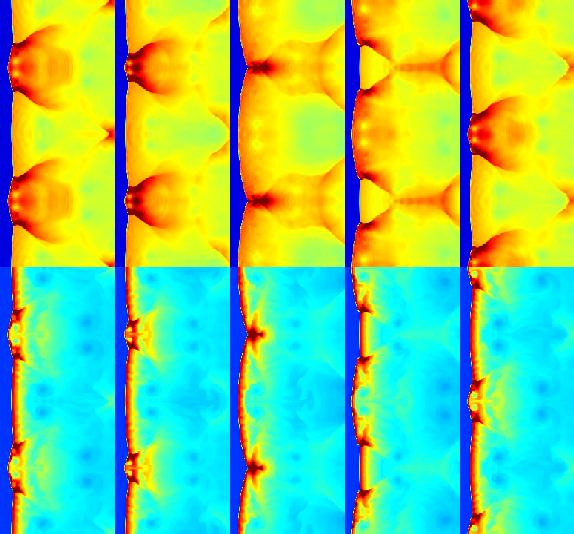
I am modelling detonations using the
Flux-Corrected Transport (FCT) algorithm both in multidimensional
geometries with single step (two species) chemistry. In the future I
may look at extending this work to mutli-species combustion. The
following picture shows the pressure and density field for a
two-dimensional detonation. The color scheme is scaled such that red
is the highest value and blue is the lowest.
(JPEG, 47 Kb)
Newest results are available on these pages. They are updated as
I get new stuff:
One-Dimensional Detonations
Two-Dimensional Detonations
Three-Dimensional Detonations
Experimental and Numerical Smoke Foils
Recent publications in this area:
- Williams, D.N., Luc Bauwens and Elaine S. Oran (1996). "Detailed
Structure and Propagation of Three-Dimensional Detonations", In the
proceedings of the Twenty-Sixth
Symposium (International) on Combustion, Naples, Italy, July
30 - August 5, 1996.
- Williams, D. N., Luc Bauwens
and Elaine S. Oran, "A Numerical Study of the Mechanisms of Reignition
in Low Overdrive Detonations", Shock Waves, Vol. 66, No. 2, pp. 93-110, Jully 1996.
- Bauwens, L. and D.N. Williams, "Computation and Visualization of Detailed
Detonation Structures", AIAA Paper 96-0343, Presented at the 33rd AIAA
Aerospace Sciences Meeting, Reno, Nevada, Jan 1996.
- Williams, D. N., Luc Bauwens
and Elaine S. Oran, "Numerical Simulation of Two-Dimensional
Unstable Detonations", Presented at the 15th International
Colloqium on Dynamics of Explosions and Reactive Systems (ICDERS),
Boulder, Colorado, August 1995.
 List of publications with downloadable postscript versions.
Visualization
Real time visualization allows me to watch my results as they are
being calculated. Currently I have the capability to do this
remotely. I can be running my computation on a computer somewhere on
the network and visualize my results on a local workstation. This is
achieved through use of public domain software and FORTRAN libraries
developed at
NCSA. For more information on real-time visualization, click here.
Publications in this area:
- Bauwens, L., Williams, D.N., Nadworny D., and Masiar P., "On-Line
Visualization on ATM Networks",
Virtual Environments
and Distributied Computing at SC'95,
Supercomputing '95
, SanDiego, December 1995.
- Bauwens, L., Williams, D.N., Phillips, D.S. and Ferrara,
M., "Remote
Computation and Visualization of Detonations Using the Canadian NTN
Testbed", In Proceedings of HPCS'95, Montreal, July 1995.
High Performance Computing
Optimization of CFD code on any supercomputer is critical in order to
maximize the spending power of your money. I have optimized my code
on both a vector and a massively parallel machines. The vector
machine is a Fujitsu VPX240 located at the
High Performance Computing Centre
(HPCC) in Calgary, Alberta. The second was a MasPar MP-2 with 8192
processors located at Research BC in Victoria, British Columbia.
Publications in this area:
- Williams, D. and L. Bauwens, "Simulation of Compressible Flow on a
Massively Parallel Architecture", Scientific Programming, Vol.
4, No. 3, pp. 193-201, 1995.
- Williams, D. and L. Bauwens, "Porting and Optimization of a
Finite-Difference CFD Code on a Massively Parallel Architecture", In
Proceedings of the International Conference - Massively Parallel
Processing - Applications and Development, Delft, The Netherlands,
June 1994.
- Williams, D. and L. Bauwens, "Compressible Flow Simulation on a
Massively Parallel Architecture", In Proceedings of the Second
Annual Conference of the CFD Society of Canada, Toronto, Ontario,
June 1994.
- Williams, D. and L. Bauwens, "Compressible Flow Simulations on a SIMD
Architecture", In Proceedings of SS'94 High Performance
Computing, Toronto, Ontario, June 1994.
Back
to my homepage.