ENME 595
Computational Fluid Dynamics Laboratory #1
 

Objectives

1. To calculate the drag coefficient of a two-dimensional cylinder over the range Re1 < Re < Re2, and compare with known values.

2. To determine the applicability of different turbulence models over the specified range of Reynolds numbers.

Background
 
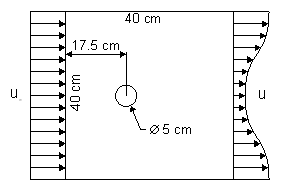
For this lab you will use a the subsonic CFD package, CFX, to simulate the flow over a two-dimensional cylinder. The problem geometry is shown on figure 1. You will run CFX and determine the drag coefficient at three different Reynolds numbers within the range defined above. Change the Reynolds number by changing the inflow velocity and/or viscosity.


Calculations, Results, and Discussion
 

1. Build the two-dimensional geometry and grid which are appropriate for the given Reynolds number. Set up the fluid volume as air with typical Calgary conditions, and set the appropriate boundary conditions.

2. Run the simulations, using the two different turbulence models available in the CFX package (k-e and k-e RNG), until a steady state is reached.

3. Determine the velocity and pressure distributions before and after the cylinder using CFX-visualize.

4. By numerically integrating the distributions from step 3, find the drag on the cylinder and then the drag coefficient of the cylinder.

5. Do both turbulence models give the same results? How well do the results agree with known values?